






Custom Men’s Coveralls Manufacturer in Bangladesh for Canadian Buyers – Exposed Zip, Pass-Through Pockets and Twill Details
As a custom men’s coveralls manufacturer in bangladesh for canadian buyers, Siatex makes a coverall that earns its place in a Canadian workplace by surviving the season. It goes on over base layers in the cold months, takes grease, dust and weather through the working day, and has to open fast with gloves on. This page covers men’s one-piece work coveralls made in Bangladesh for Canadian buyers, built in deep green cotton twill with an exposed brass zip and room to layer underneath.
Materials: The body is a sturdy cotton twill with the diagonal weave visible across the surface. Twill is the classic workwear cloth because the diagonal structure takes abrasion well and the cotton face stays comfortable against layers worn underneath through a long shift.
Functionality: An exposed brass zip runs up the front where gloved hands can find it, and pass-through slits at the hips reach the pockets of trousers worn below. Two open chest pockets, a sleeve utility pocket and two back pockets carry the small tools of the day.
Size: The coverall is graded across men’s sizes S to 3XL, with body length, sleeve and leg set per size. The cut leaves room through the chest and seat for the layers a Canadian crew wears under a coverall for much of the year.
Customisation: Buyers set the twill colour, the pocket layout, the cuff and waist finish and the woven label inside the back neck. A distributor can run one coverall across several industries by holding the build constant and varying colour by contract.
Get Price: Send your size breakdown, colour and pocket requirements through our contact page for a quotation. As a custom men’s coveralls manufacturer in bangladesh for canadian buyers, we price the cloth, hardware and making together as one finished garment.
A one-piece garment has nowhere to hide weak work. The zip takes the strain of every wearing, the waist decides whether the wearer can bend and reach, and the pockets decide whether the garment is useful or just covering. The points below set out how this coverall is built before an order is confirmed.
Cotton Twill with a Visible Diagonal Weave
- The cloth is a sturdy cotton twill with a matte workwear face.
- The diagonal weave takes abrasion better than a plain weave.
- The face stays smooth enough to brush clean at the end of a shift.
- Colour is even across the body, sleeves and legs of each garment.
Exposed Brass Zip Up the Front
- The metal zip sits exposed at the centre front, easy to find and grip.
- Brass teeth and puller are chosen for repeated daily use.
- The zip runs from the collar to the waist seam in one length.
- The top of the zip is anchored with reinforced stitching.
Open Chest Pockets and a Sleeve Utility Pocket
- Two open patch pockets sit on the chest for quick access.
- Pocket corners are bartacked where hands pull at them daily.
- A utility pocket on the left sleeve carries pens and small tools.
- Two back patch pockets complete the carrying layout.
Pass-Through Slits at the Hips
- Open slits at both hips reach the pockets of trousers worn underneath.
- The slit edges are bound and reinforced at both ends.
- The openings sit under the waist seam, clear of the zip line.
- Access works with the coverall zipped fully up.
Elasticated Waist and Back Action Pleats
- An elasticated waist section gives as the wearer bends and reaches.
- Action pleats below the back yoke add room across the shoulders.
- Long sleeves end in buttoned cuffs that close over glove tops.
- Straight full-length legs are hemmed to finish over work boots.
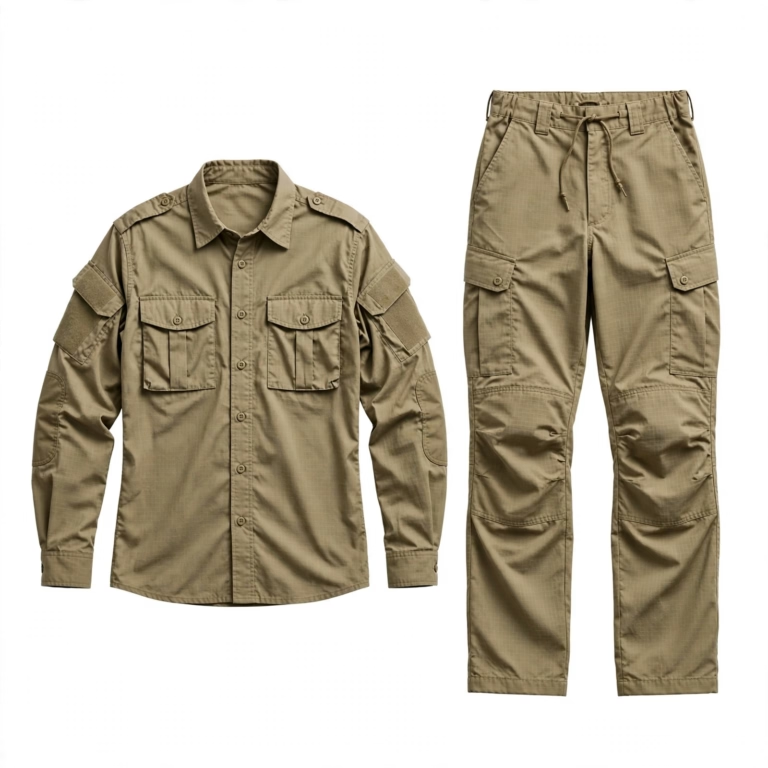
Buyers comparing builds can also see the companion style on our workman coveralls page, which runs a concealed zip and flapped chest pockets in khaki. The two garments share the same making standard while serving buyers who prefer different fronts and pocket layouts.
| Style | Men’s one-piece work coverall with an exposed front zip |
|---|---|
| Fabric | Sturdy cotton twill with a visible diagonal weave |
| Colour | Deep green as pictured, with buyer colourways across the range |
| Front | Exposed brass zip from collar to waist, point collar above |
| Pockets | Two open chest pockets, sleeve utility pocket, two back pockets, pass-through hip slits |
| Waist | Elasticated waist section with action pleats at the back shoulders |
| Sizes | Men’s S to 3XL, graded as a set with layering room |
| Label | Buyer woven label inside the back neck, reading YOUR LABEL in the sample |
Coveralls for Canadian Industrial, Farm and Municipal Crews
Industrial crews wear coveralls because one garment covers the whole working layer. In plants, workshops and warehouses across Canada, the one-piece goes over everyday clothes in the morning and comes off at the end of the shift, keeping the dirt of the day on the twill rather than on the wearer.
Farm and municipal work makes the same demand outdoors. A coverall that zips fast, reaches the pockets underneath and leaves room for a fleece in the cold months suits the way Canadian outdoor crews actually dress, which is in layers that change with the weather through a single day.
Working with a custom men’s coveralls manufacturer in bangladesh for canadian buyers lets distributors and uniform suppliers set that build once and hold it across contracts. The garment stays constant while sizes, colours and labels vary by the crew wearing it.
How a Canada Coverall Order Runs from Twill to Shipment
An order begins with the build sheet: twill colour, zip and pocket layout, and the size grading with its layering room. A sample coverall is made so the buyer can check the zip action, the waist give and the pocket positions on a real garment before the run is cut.
Once the sample is approved, the twill is cut with the one-piece panels planned to keep the diagonal weave running evenly across the garment. Zips, pockets and pleats are sewn in sequence, and the long seams are double-stitched where a coverall takes its hardest wear.
Finished coveralls are checked, pressed and folded by size. Buyers running a wider workwear programme can source the casual layers crews wear underneath from our t-shirt manufacturing range, keeping one supplier across the kit.
Zip, Pocket and Waist Checks in Bangladesh
The zip is checked the way a wearer uses it: run fully up and down, again and again, feeling for any catch. The puller must sit flat, the teeth must mesh evenly from bottom to top, and the anchor stitching at both ends must be tight.
Pockets are checked for position and strength. Chest and back pockets must sit level in pairs, the sleeve pocket must sit straight on the arm, and every pocket corner takes a firm pull test, because pockets fail at corners long before they fail anywhere else.
Our quality assurance process covers the waist and pleats as well: the elastic section must stretch and recover evenly, and the action pleats must open and settle flat. A coverall that passes is one a crew can put straight to work.
Room to Layer Under a Canadian Work Coverall
Layering is the quiet specification behind this garment. For much of the Canadian year a coverall is not worn over a t-shirt but over thermals and a fleece, so the chest, seat and sleeves are cut with the extra room those layers need, without letting the garment hang loose in summer.
The elasticated waist and back pleats do the adjusting. The pleats open when the wearer reaches or climbs, and the waist gives when the layers underneath are thick, then both settle back when the wearer stands straight. The garment fits the day rather than one fixed shape.
This is where a specialist custom men’s coveralls manufacturer in bangladesh for canadian buyers earns the order: grading that room correctly across S to 3XL, so the largest size carries the same working ease as the smallest, is pattern work, not guesswork.
Sizes, Colours and Packing from Your Coverall Supplier in Bangladesh
The size run covers men’s S to 3XL, graded as a set. Body length matters on a one-piece more than on any other garment, so the rise and leg are graded with the chest rather than stretched from one base size, and tall crews are not left pulling at the shoulders.
Colours are set by the buyer. Deep green as pictured suits farm, grounds and workshop work; distributors often run a small colour family across their contracts, with the same build and pockets held constant so crews recognise the garment whatever the contract colour.
Each coverall is folded and bagged individually with its size marked clearly. Buyers stocking the layers worn underneath can add basics from our blank t-shirt programme to the same ordering relationship.
Your Own Label Inside Coveralls from a Bangladesh Factory
The woven label inside the back neck carries the buyer’s own name, as the YOUR LABEL sample on this page shows. For a uniform supplier or distributor, that label turns a sourced coverall into their own product, the one their customers ask for again by name.
Own label work runs through the whole garment. Care and size information is set with the buyer for the Canadian market, and the label is sewn in during making rather than added afterwards, so it sits as neatly as every other part of the garment.
Continuity is the commercial point. The label artwork, the twill colour standard and the grading are kept together, so a reorder for a new contract or a growing crew comes back matching the coveralls already in service.
Where We Ship Your Coverall Order
Coverall programmes follow the working year, and orders leave Bangladesh for the markets where our buyers supply crews. Canada leads this page, and the main destinations are set out below.
Canada
Canadian distributors and uniform suppliers are the lead buyers of this coverall, ordering graded size runs for industrial, farm and municipal crews.
United States
American workwear buyers order the same build for workshop and warehouse programmes, packed to their size breakdowns.
United Kingdom
British buyers take twill coveralls for engineering and grounds work, with own label finishing inside the neck.
Germany
German buyers value the double-stitched seams and even grading, and order steady repeat programmes in core colours.
Australia
Australian buyers order the coverall in lighter seasonal runs for farm and workshop crews.
France
French workwear suppliers take the style in contract colourways, holding the pocket layout constant across colours.
Quality Checks Before Your Coveralls Leave Bangladesh
Every coverall is checked at the points hard use will test. The zip must run cleanly, the pocket corners must hold, the elastic waist must recover, and the long double-stitched seams must run straight with no skipped stitches.
Measurements are checked against the approved sample size by size, with body length checked as carefully as chest width, because a one-piece that is short in the body fails its wearer every time he bends. Colour is compared across panels under consistent light.
Only coveralls that pass are folded and bagged. Buyers can also review how cotton sourcing is certified through Better Cotton, whose published work explains the standards behind more responsibly grown cotton in workwear cloth like this twill.
Why Canadian Buyers Make Coveralls in Bangladesh
Bangladesh offers workwear buyers the full chain in one place: weaving, dyeing, cutting and sewing inside one mature industry. A twill coverall with hardware, pockets and pleats needs every step working together, and one country keeps the standard under one roof.
The buyer also gains a programme rather than a batch. With a custom men’s coveralls manufacturer in bangladesh for canadian buyers holding their pattern, colours and label, the next contract order starts from a proven garment instead of a new development.
Workwear rewards that reliability. Crews reorder the coverall that survived last season, and the supplier whose name is inside it keeps the contract when the garment keeps its promises.
Care and Working Life of a Cotton Twill Coverall
A twill coverall is washed like the work cloth it is. A normal machine wash keeps the cotton clean, and shaking the garment out before hanging helps the long panels dry evenly. The brass zip is best left closed in the wash so the teeth run smoothly afterwards.
Cotton twill softens slightly with washing while keeping its structure, which most wearers count as comfort rather than wear. The diagonal weave resists the surface abrasion of benches, bales and machinery better than a plain weave of the same weight class.
The parts that decide the garment’s life are the parts checked hardest: zip, pocket corners, waist elastic and seams. When those are built and checked properly, the coverall’s working life is measured in seasons, not months.
Frequently Asked Questions
Is the front zip covered or exposed?
Exposed. The brass zip sits at the centre front where a gloved hand can find it fast, which Canadian crews ask for by name. Buyers who prefer a covered front can see the concealed-zip companion style on our workman coveralls page.
Can the coverall be worn over winter layers?
Yes. The cut leaves room through the chest, seat and sleeves for thermals and a fleece, and the elasticated waist and back pleats adjust as layers change. Industrial and farm buyers in Canada grade their orders on exactly that basis.
What sizes does the coverall come in?
Men’s sizes S to 3XL, graded as a set with body length graded alongside chest width. A one-piece lives or dies by its length, so the rise and leg are never simply stretched from a smaller size.
Does it have pockets for tools?
It has two open chest pockets, a utility pocket on the left sleeve and two back patch pockets, plus pass-through slits at the hips that reach the trousers underneath. Uniform suppliers in the USA and the UK order this layout for workshop crews.
Can the coverall carry our own label?
Yes. Your woven label is sewn inside the back neck during making, as the YOUR LABEL sample shows. Distributors in Canada and Germany build their contract workwear around that label, with care details set for their market.